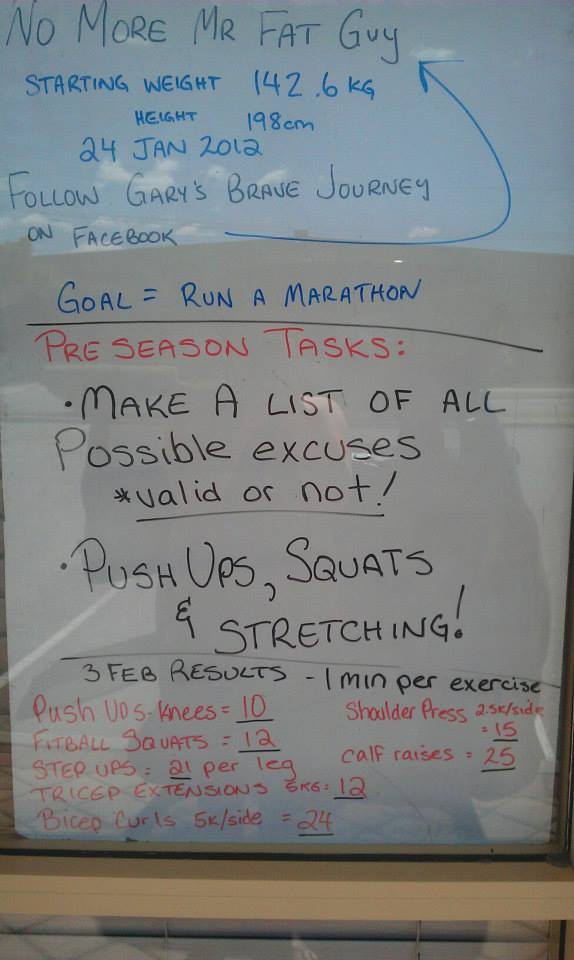
no more mr fat guyBack in the days of no more mr fat guy
Six Hours, Forty-Seven Minutes
The Perth Marathon was supposed to be the impossible finish line. It became cold fog, Heartbreak Hill, help from Chris and Derryn, Kian near the finish, and 6:47 of proof that changed what I believed was possible.

At the 41 km marker, with 1.1 km left, I said it out loud.
I was going to run the whole thing from there.
Not because I had suddenly discovered some elegant final gear. There was nothing elegant left. By that point I had been out there for well over six hours. My legs were cooked, my quads had been mugged by a hill that had no business appearing in my first marathon, and the aid stations behind me were packing up because I was the final runner on the course.
But I could see the roof of the clubrooms.
The finish was no longer an idea. It was a place.
I had spent eighteen months getting myself to that morning and eighteen weeks specifically training for it. I had started as a 142.6 kg bloke trying to walk the dog for twenty minutes and not become another heart-attack statistic. I had rowed until I could row marathon distance. I had slowly, grudgingly, suspiciously added running into the mix. I had put a whiteboard up with the words “Goal = run a marathon” written on it, as though writing the absurd thing made it slightly less absurd.
Now the absurd thing was one point one kilometres away.
So I said it. With Chris beside me, with whatever was left of my voice, with the last little pocket of stubbornness I could find:
I was running from here to the finish.
That was the promise.
But to understand why that mattered, I need to go back to the day before.
Marathon Eve
The Saturday before the Perth Marathon felt like Christmas Eve, if one of the presents waiting under the tree was several hours of voluntary physical punishment.
I called it marathon eve because of course I did. By then the anticipation had taken over everything. The final week before the race had been almost comically careful. I was worried about stupid things taking me out at the last minute: one of the kids bouncing on my legs, the dog standing on my toes, a cold, a stomach bug, anything ridiculous enough to undo months of work. My training runs had shortened. Rest had become the thing I was meant to do, which is always much harder than it sounds once your head has started treating movement as medicine.
From my office I could see a large part of the Perth Marathon course. That did not help. Every workday it sat there in front of me, looking harmless from a distance. River, paths, bridges, foreshore. It was almost rude how ordinary it looked. There was no visible warning label saying, “This will hurt.”
By Friday, everything had narrowed around Sunday morning.
I had tested a water bottle belt and the thing had failed almost instantly, one bottle falling out and cracking its cap. So that was that. I would do what I had done on the 32 km training run and carry a bottle of homemade sports drink in my hand. Low tech, slightly daft, but tested. Reliability mattered more than looking like a proper runner.
The bigger stuff was happening underneath.
On marathon eve I was thinking about the 14-year-old version of me again.
He had appeared properly at Joondalup four weeks earlier, somewhere on the long climb around the lake, telling me I did not belong there and should stop. I named him because naming him helped. Fourteen-year-old Gary: self-conscious, shy, awkward, desperate not to be seen trying and failing. The boy who hated running. The boy who knew the safest place was inside known limits. The boy who had turned not doing things into a kind of protection.
I had spent years thinking the marathon goal was about weight, fitness, health, maybe ego. All of that was true enough on the surface. But the closer I got to race day, the more it became obvious that I was trying to answer something older.
Running a marathon had never been the whole dream.
Secretly, I had wanted to become the kind of person who could run one.
That is a different thing.
Eighteen months earlier, if you had asked me what would happen after Perth Marathon, I would probably have said the job would be done. Goal reached. Chapter closed. Nice medal, good story, go back to something quieter.
By the night before the race, I already knew that was wrong.
The long runs had done things I had not expected. The blog had done things I had not expected. The training had peeled away bits of me I had treated as permanent. It had opened doors I had long ago convinced myself were locked, or maybe not worth opening in the first place.
So yes, Sunday was about 42.2 km.
It was also about whether 14-year-old Gary got another chance.
The Back Of The Pack
Race morning began around 4:30 am with the breakfast of a condemned man: porridge, toast, orange juice. I showered, got into my running gear, and packed the practical little bag of race-day reassurance: ice gel, keys, wallet, change of T-shirt, towels. Ordinary objects, but each one part of a ritual. Keep the hands busy. Calm the nerves. Make the next step obvious.
Around 6:15, the family got into the car with me, dragged into a cold foggy winter morning while still working through their own breakfasts.
I thought of them as witnesses.
That sounds dramatic, but it was how it felt. Not witnesses to my glory, because glory was very much not guaranteed. Witnesses to the planned execution of the old me. Mr fat guy. The version who had accumulated excuses until they looked like identity. The version who could always explain why the big thing would not happen.
At Burswood, I felt out of place immediately.
Joondalup had been intimidating, but this was worse. There were no fun-run costumes, no comforting haze of casual participation, none of the “well, everyone is just having a go” energy I could hide inside. This felt like a real running event full of people who knew exactly what they were doing.
Of course, that was mostly my own nervous brain being theatrical. Plenty of runners were just chatting, laughing, catching up, doing normal human things. But I could not stop the voice in my head from asking the obvious question.
What are you doing here?
Scott from work appeared at exactly the right sort of time. He was an experienced runner, aiming for something under three hours, which from my end of the field sounded like teleportation. But he was relaxed, friendly, part of that running community I was only beginning to understand. A photo was taken of us together. He looked ready to run a marathon. I looked like a man trying very hard to remember that he had chosen this.
Then it was time to move towards the start.
I went to my usual place: the back.
There I saw Brian, someone I had been chatting with through the Facebook page. We said hello, shook hands, and settled into that strange pre-race bubble. Runkeeper on. Earphones in. Eyes fixed on the countdown.
When the display clicked down to 30 seconds, I pressed start.
There were maybe six or seven hundred of us about to run 42.2 km on a crisp, cold Perth morning. The leaders would disappear almost instantly. I would spend most of the day negotiating with my legs, my head, my pride, and whatever else showed up after the easy kilometres ran out.
Then we were off.
I made the same mistake I had made at Joondalup.
Too fast.
Runkeeper told me after the first kilometre. It told me again after the second and third. My intended pace had been sensible. My actual pace was being driven by nerves, adrenaline, excitement, and the simple fact that almost everybody else was moving faster than me. It is hard to let a field go, even when you know letting them go is exactly what you are supposed to do.
Brian was nearby for a while. He had talked about finishing in about six and a half hours, and I quietly decided that if I stayed somewhere near him, I might be all right. Then I started doing the dangerous early-marathon maths.
Maybe the taper had worked.
Maybe the carbs had worked.
Maybe the doing almost nothing in the final week had created some magical stored-up version of me who could run a marathon much better than expected.
Maybe five and a half hours was possible.
This is how marathons bait you.
The early course was beautiful. I made my way through East Perth, over the Causeway, along the South Perth foreshore, and waved to my family, who had taken the sensible option and driven. I was moving. I was smiling. The morning was cold and clear. The river looked magnificent. The city sat across the water with that faint winter haze around it.
For a while, it felt almost easy.
That was the trap, obviously, but I did not know it yet.
I passed the first relay change area and let myself enjoy the crowd as though they were there for me. I went under the Narrows Bridge and along the shared path beside the freeway. Brian was still visible in the distance. I had even passed a couple of people, which meant I was not last.
More importantly, the mental rubbish from Joondalup had not arrived.
Fourteen-year-old Gary was quiet.
I reached Canning Bridge feeling as though maybe I really had done the work. Just before I got there, I saw Scott heading back the other way with only about 10 km of his race left. I was still going out. That was both funny and mildly horrifying.
Still, I felt strong.
Heartbreak Hill
Then came Fraser Road.
The course had a late diversion because of boardwalk maintenance. Instead of staying on a flatter riverside section, we had to go up and over a steep hill. I had been told about the diversion. Being told about a hill and meeting it after 20-odd kilometres are not the same experience.
I turned the corner and saw it.
Heartbreak Hill. That is what I called it, and I stand by the nickname.
For a car, it would have been nothing much. For a large, slow, first-time marathoner already deep into the biggest physical effort of his life, it was savage. The climb hurt, but the descent may have been worse. It blasted my quads, emptied the fuel tank, and changed the entire feeling of the day.
In a few hundred metres, the pleasant riverside jog became survival maths.
Somewhere after the hill, two women joined me for a while. They were not in the marathon. They were training for a 48-hour, 100 km walk, which should probably have made me feel better about my own life choices but did not. I was “running”; they were walking. And they were still helping me.
They chatted. They buoyed me. They made a hard stretch feel less lonely.
That became one of the truths of the day. I finished the marathon, yes, but I did not get there alone.
The turnaround came somewhere around 24 or 26 km. By then I was well outside anything that felt comfortable. There were about 16 km still to go, which is a ridiculous distance to have left when your body has already started sending strongly worded letters of complaint.
At each water station, I thanked the volunteers and apologised for making them wait so long.
Every time, they smiled.
Not a problem.
It’s our pleasure.
They were brilliant. I was slow enough to see how much of an event depends on people who stand around in the cold for hours so that someone like me can keep moving.
Somewhere around 28 km, I was overtaken.
Lucky last.
It did not matter.
That is not bravado. It really did not matter. The race had already stripped itself down to the only thing that counted. Finish. Get to the end. However ugly it looks, however long it takes, however far behind everyone else you are, keep going.
Then Fraser Road came back.
This time the climb was slow and grim, and the descent was a quad-crushing shuffle. I gave up any remaining fantasy of running the whole marathon. I walk-jogged up. I limped down. If anyone had been watching closely, they might have assumed the path was covered in glass and my shoes had vanished.
It probably would have hurt less.
Thirty-One Kilometres
Then came Canning Bridge again, and with it the 31 km sign.
I did not expect what happened next.
The sign hit me with emotion. Proper emotion. Wet corners of the eyes, breath caught, the kind of feeling I had only really known when my children were born. That sounds wildly disproportionate for a number on a sign, but the number carried everything waiting behind it.
It meant I had 11 km left.
It meant I was on the way home.
It meant the dream had become smaller than a Sunday training run.
For a few moments, I loved that 31 km marker as though it had done something for me personally.
Then, almost immediately, I crashed.
Somewhere between 31 and 32 km, my positive mindset operating system failed. I was still physically able to move, but the long straight freeway cycle path stretched ahead of me in the most mentally brutal way possible. There was no drama to it. No mountain. No scenic excuse. Just a straight, dull, exposed section inviting me to stop caring.
I was doing tiny intervals by then. Twenty seconds jogging, twenty or thirty seconds walking. Repeat. Bargain. Repeat. Try not to think about how far was left. Fail. Repeat anyway.
That was where Chris appeared.
I still do not properly know why he was there at that exact moment. He had been supporting a mate in the marathon and somehow, just as I was approaching a very dark patch, he was on the freeway cycle path with a bike and enough generosity to spend part of his morning beside a struggling stranger.
Chris van Dorssen became, in my head and on the Facebook page the next day, my marathon guardian angel.
He rode beside me for three or four kilometres. He talked. Encouraged. Distracted. Took the edge off that horrible straight stretch. Somehow, with him there, I jogged two or three kilometres without walking.
That was not a small thing.
Momentum came back. Spirits lifted. The task became possible again.
After the Narrows, we parted. I shook his hand and warned him he would be mentioned in the blog. He had no idea yet how deeply he had just written himself into the story.
A kilometre or so later, the engine sputtered again. I was back to walk-jog intervals, but now the doubt had changed shape. With 10 km to go, finishing had still been negotiable in my head. With about 5 km left, even if I had to crawl home metaphorically, I was going to make it.
Then another person joined the small army.
Derryn, a WAMC volunteer, kept me company along the South Perth foreshore. Because I was last, each checkpoint and drink station could pack up as I went past. That could have felt humiliating. Instead, with someone there, it became almost companionable. There was no pretending I was not last. There was also no shame in it.
I was still moving.
Just before the 2 km mark, I heard a voice.
“What are you doing walking, Gary?”
Chris was back.
He had decided to jog the last couple of kilometres with me.
Bloody brilliant.
The Final 1.1 Kilometres
That brings me back to the 41 km marker.
The finish was visible now. The clubrooms were there. The remaining distance was small enough to hold in my head all at once.
I said I was going to run the whole way.
At about 500 metres to go, my mind flashed to training runs near home, that feeling of being close to the traffic lights, close to the turn, close enough to stop bargaining and just finish the thing. Then I saw Kian to my right.
He was excited.
He wanted to run beside me.
Of all the ways the final few hundred metres could have happened, that was the one that made sense. My son had been one of the reasons I started. One of the reasons I had to stop being the unhealthy, unhappy, excuse-making version of myself. And now he was there, running the last little stretch with me, as though the whole absurd eighteen-month project had been leading to that small pair of legs beside mine.
With 100 metres to go, I started striding out.
Fifty metres.
Twenty-five.
Ten.
Six hours, forty-seven minutes.
I finished.
Last, yes. Last of 655 people, as the workplace clipping would later point out. But last place got the same finish line. Last place got the same medal. Last place still meant I had covered 42.2 km on foot.
I have two memories of what happened immediately after, and they both feel true. One is that I was so shattered I would have cried if I had the energy. The other is simpler: I cried. The finish was messy like that. Physically exhausted, emotionally split open, not fully registering who put the medal into my hand or around my neck, vaguely aware of congratulations, a high five and hug from Chris, my family nearby, and the enormous fact sitting in the middle of it all.
I had done it.
I f*cking did it.
After The Medal
The meaning did not arrive all at once.
On the Tuesday I wrote that I was still alive, both in the obvious sense of not having had a cardiac incident while attempting a marathon, and in the deeper sense of feeling alive. That morning I did a gentle 5 km recovery jog at 3:45 am. The running habit had survived the finish line.
By that night I was drained and moody.
Nobody warns you properly about that bit.
The week after the marathon felt like the longest hangover ever. Not a normal hangover, but the strange emotional aftermath of having chased something for eighteen months and then actually caught it. There was pride, flatness, sadness, a slightly smug glow, and a desperate little itch to recreate the feeling. I wanted to sleep. I wanted to run. I wanted to understand what had just happened.
The answer, at least the beginning of it, was that I had become a runner.
Not a fast one. Not an elegant one. Not someone who looked particularly athletic. But my feet wanted to get back outside. My heart wanted the dark solitude of an early run. The habit had taken hold, and the period of rest after the marathon felt less like reward and more like withdrawal.
Then the bigger question opened.
The original goal had been reached. Run a marathon. That was the whiteboard line. That was the impossible thing. That was the answer I had given myself when I asked, back at the start, what the hardest possible thing might be.
But now what?
Over the next few days, the shape started to change. I still wanted to run. I still wanted to blog. But I also wanted no more mr fat guy to become more than another weight-loss or running blog. I wanted to use the whole messy process of getting fit, getting moving, getting brave, and getting honest as a way to contribute something.
I did not have Hearts Across Australia yet.
I did not have Perth to Brisbane.
I did not have the Heart Foundation layer, the long walks, the support crew, the roadhouses, the Nullarbor, the rest days, the hard conversations, or the hundreds of little practical decisions that would eventually turn an idea into a crossing.
What I had was proof.
Quiet proof. Exhausted proof. Six-hours-and-forty-seven-minutes proof.
The marathon did not make me suddenly fearless. It did not fix everything. It did not turn me into a motivational poster, thank goodness. But it broke one of the old arguments. The one that said I was not the sort of person who could set a huge goal and actually reach it. The one that said big things were for other people. The one 14-year-old Gary had carried for far too long.
When I limped back to the car with my family, I had no idea where the next version of the story would go.
But I knew the old version of me had lost a lot of credibility.
Images From The Day